
Should You Report AP Scores to Colleges? What
Families Need to Know in 2026
AP scores are out. Should you report them to colleges? A
college consultant explains when to send AP scores, when to hold back, and which schools require all.
Let’s Build Your Student’s College Success Plan
Schedule a no-obligation strategy call and get clarity on your college planning path.
AP scores just dropped, and so did a lot of stomachs.
Every July, my inbox fills with the same two questions: “Is this score good enough?” and “Do I have to send it?” Here’s the truth I want every family to hear before anyone touches the Common App: the score you earned and the score you report are two different decisions. One already happened. The other is still yours to make.
Reporting AP scores isn’t an obligation you owe the colleges. For the vast majority of schools, it’s a strategy, and used well, it can strengthen an application instead of quietly working against it. Let’s walk through how to decide.
First, a mindset shift: reporting is optional more often than you think
Most colleges let you self-report AP scores, which means you type them into the application yourself rather than sending an official College Board score report. And here’s the part families miss: if a college doesn’t require all your scores, you get to choose which ones to include. You are not lying by leaving a score off; you’re curating, the same way you choose which activities and awards to highlight.
The moment a score appears in your application, it becomes fair game something admissions officers can weigh. A strong score helps you. A weak score you volunteered can only hurt you. So, the question is never “Did I pass?” It’s “Does this score make my case stronger?”


Do AP scores actually matter for college admissions?
Yes — more than some social-media “experts” will admit. At the most selective colleges, AP exam scores are one more data point that helps admissions officers confirm you can handle rigorous, college-level work. A 5 signals mastery. A 3 — even though the College Board calls it “qualified” — can read as a soft spot at a school admitting single-digit percentages of applicants. Sometimes even a 4 gives a top-tier reader pause.
That does not mean AP scores make or break every application. At the large majority of colleges, a passing score is genuinely fine, and a missing score is a non-event. The stakes rise as selectivity rises. So, calibrate your reporting decision to the kinds of schools on your list, not to a one-size-fits-all rule from the internet.
Which colleges require all AP scores to be reported?
Very few. As of the 2026 cycle, a small number of highly selective schools ask applicants to
report every AP score, while others strongly encourage it. Policies change year to year, so treat
this as a starting point and always confirm on each college’s official admissions or testing
page before you apply.
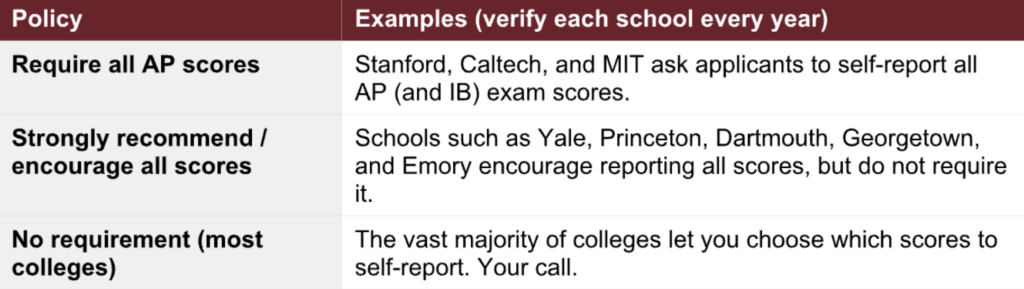
Bottom line: if a school requires all scores, report them all — honesty and integrity are non-negotiable, and getting caught omitting scores is far more damaging than a middling number. If a school doesn’t require them, you decide.
What counts as a “good” AP score — and does a 5 beat a 4?
At elite colleges, yes: a 5 is meaningfully better than a 4. I know some admissions influencers insist there’s “no difference.” Many of them have never sat on the other side of an admissions desk. A 5 is the strongest signal the exam can send, and top schools notice the distinction — especially when a lot of your applicants are reporting 5s.
For most colleges, though, a 4 or even a 3 is perfectly respectable and can earn you credit or placement. Don’t spiral over a single number. Instead, ask how that number reads next to the specific schools you’re targeting.


Match your AP scores to your intended major
This is where reporting gets strategic. A 5 on an exam that lines up with your intended major is gold: it tells a college you’re strong precisely where you say you want to go. A future engineer reporting a 5 on AP Calculus BC or AP Physics C is reinforcing the story. A future engineer reporting a 3 on that same exam is quietly undercutting it.
When you have discretion, lead with the scores that support your academic direction and think twice about volunteering low scores in your core subject.
The grade in the class still matters more than the exam score
Here’s a truth that survives every year’s grade-inflation debate: an A in the AP course generally carries more weight than a 5 on the AP exam. Admissions officers see your transcript on every application; the exam score is supplemental. That said, the two talk to each other. A C in AP Calculus BC paired with a 5 on the exam won’t erase the C, but it softens it, showing the material clicked even if the semester was rocky.
Admissions reporting vs. college credit: two separate things
Families conflate these constantly, so let’s untangle them. Choosing not to report a score on your application does not stop you from claiming credit for that same score once you’re admitted and enrolled. Credit is handled after you commit, through the college’s registrar, using
an official College Board score report. So, holding a 3 back during admissions doesn’t cost you the credit later if the school grants it.
A quick word on AP Scholar awards
AP Scholar awards can go in the honors section, but pause before you list one. These awards don’t change admissions decisions the way scores can, and they’re fairly common. If you’ve chosen not to report some scores, an AP award can backfire: it flags that you earned recognition tied to exams you didn’t show. Make sure your honors and your reported scores tell a consistent story.


What if your school doesn’t offer APs — or forces you to take the
exam?
Two reassurances. First, if your high school doesn’t offer AP courses, no college expects you to self-study and sit for AP exams on your own. You’re evaluated in the context of what your school offers. Second, if your school requires you to take the AP exam whenever you take the AP course, that requirement is between you and your school; it doesn’t obligate you to report those scores to colleges that don’t require them.
A simple framework for deciding which scores to send
When a college doesn’t require all scores, run each one through these questions:
- Is it required? If the school requires all scores, report everything. Stop here.
- Is it a 4 or 5? Strong scores almost always help; report them.
- Does it match my major? A high score in your intended field is a priority to include; a low one is a reason to hesitate.
- How selective is the school? The more selective, the more a 3 (or shaky 4) can hurt when it’s optional.
- Does it stay consistent with my honors and story? Don’t list an AP award while hiding the underlying scores.
Reporting is strategy — and strategy is what we do
Deciding which AP scores to send isn’t about gaming the system. It’s about presenting an honest, sharp, self-aware application to the schools that fit your student. That takes context most families don’t have on their own, and it’s exactly the kind of decision we make with our students every day.
If your family is staring at a screen of AP scores wondering what to do next, let’s talk it through together. Schedule your no-obligation strategy call, and we’ll help you build a reporting plan and an application that opens doors.

Frequently asked questions
Do you have to report all your AP scores to colleges?
No. Only a few highly selective schools such as Stanford, Caltech, and MIT require you to report all AP scores. Most colleges let you self-report and choose which scores to include. Always confirm each school’s current policy before applying.
Should you report a 3 on an AP exam?
It depends on the school and the subject. At most colleges, a 3 is fine. At highly selective schools, an optional 3 (especially in your intended major) can work against you, so many students choose not to report it unless the college requires all scores.
Will not reporting an AP score hurt my application?
Generally, no. When a college doesn’t require all scores, leaving one off is a non-event, and a school can’t penalize you for a score it never saw. Reporting a weak score, however, gives them something concrete to weigh, which is why the choice matters.
Does not reporting a score mean I lose AP credit?
No. Admissions reporting and college credit are separate. You can withhold a score during admissions and still claim credit for it after you enroll, using an official College Board score report through the registrar.
Is a 5 really better than a 4 for admissions?
At elite colleges, yes. A 5 is the strongest signal the exam offers, and top schools notice the difference. At most other colleges, a 4 is excellent, and the distinction matters far less.

About the Author
Shellee Howard
Founder & College Planning Strategist
Shellee helps families navigate the college admission and financing process with clarity and confidence.